FRP Van Body Lining Panels: Why Mechanical Performance Specs Matter More Than Surface Finish
Jun 02, 2026
The panel surface that actually matters is the one that's still intact and holding up three years into active loading cycles. Not the one that photographs well right after installation. If the lining has developed impact cracks, surface delamination, or failures around fastener points somewhere in year two, none of the initial gloss readings mean a thing.
Impact vs. Abrasion - Not the Same Problem
This problem has very little overlap with moisture resistance or gloss retention. It needs a different conversation at the specification stage.
Impact resistance and abrasion resistance often get lumped together in casual discussion about FRP panels, but they are distinct properties, controlled by different parts of the laminate.
Impact resistance comes down to resin system and laminate structure. A resin that has some give to it absorbs localized impact energy by deforming elastically. A resin that's too stiff transmits the shock straight to the fiber-matrix interface where cracks start. Fiber distribution matters too. Well-dispersed glass fiber spreads the stress across a bigger area. Localized fiber bundles create preferred crack paths that the impact follows.
Abrasion resistance is mostly the gelcoat's job. Surface hardness determines how fast repeated sliding contact wears through the top layer. Once the gelcoat goes, moisture gets in and the failure mode shifts from surface wear to something structural.
A panel optimized for impact and a panel optimized for abrasion are not the same panel. For van body lining where both matter, you can't spec the resin and the gelcoat independently and expect it to work out.
Edges and Fasteners - Where Panels Actually Fail
If you ask people who actually deal with van body linings in service where panels fail, they'll point you to edges and fastener locations. Standard datasheets barely touch this.
Van body linings are mechanically fastened. That means cut edges and fastener penetrations where the gelcoat protection is gone, the fiber reinforcement is interrupted, and stress concentrates. Add road spray, humidity cycles, and temperature swings to those locations and you've got the primary path for moisture ingress and corrosion at the panel-structure interface.
Standard mechanical test data doesn't tell you what happens at edges. Impact strength numbers, flexural modulus, surface hardness readings - none of that captures edge behavior. What matters in practice is how the edges get specified. Whether cut edges are sealed. What pull-through resistance the laminate supports at the fastener spacing the body design uses. Whether the thickness and fiber distribution can handle the specific fastener pattern.
These are as much installation and design questions as material questions, but they're worth putting to the panel supplier before things are locked in. Especially if the truck body uses non-standard fastener spacing or edge trim details.
A Word on Thickness
Thickness selection for van body linings has a tradeoff that's particular to this application.
Thicker panels handle impact better and give you more fastener pull-through resistance. But they add weight and eat into internal cargo volume. In a standard commercial van body, even a few millimeters of lining thickness per side reduces the internal width enough to affect pallet fit.
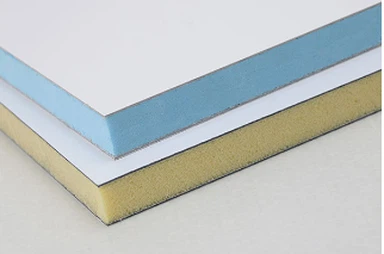
Van body linings typically run 1.5mm to 3mm for single-skin FRP. Thicker sandwich panels show up when the application also wants thermal or acoustic performance - as in reefer bodies. Within that range, a well-specified 2mm panel will outperform a poorly specified 2mm panel by a wider margin than stepping up from 2mm to 3mm of the same grade. Thickness is just not that useful as a specification lever compared to laminate quality and gelcoat formulation.
Panels at the low end of the thickness range with enough fiber content and a high-hardness gelcoat will beat thicker panels with uneven fiber distribution or a soft surface layer in the mechanical failure modes that actually matter for van body service.
Glossy Doesn't Mean Tough
One more thing worth getting straight early: surface finish.
High-gloss or mirror-finish gelcoat panels sometimes get specified for cargo area interiors because smooth equals easy to clean. That's not wrong, but there's a catch. High-gloss formulations are not always optimized for hardness.
For a truck cargo area where abrasion resistance matters more than how the surface looks, a matte or semi-gloss gelcoat formulated for hardness is usually the better call.
If the end use involves food-grade or pharma cargo where cleanability is a real hygiene requirement, then surface finish warrants a closer conversation with the manufacturer. For general dry freight hauling, don't default to the highest gloss level on the assumption that it's the best surface.
Before You Lock in a Spec
Before finalizing a van body lining panel specification, here's what to pin down with the supplier:
What resin system are they using, and how was flexibility characterized - especially if the truck will operate across wide temperature ranges.
What's the gelcoat hardness spec, and was it chosen for abrasion-dominant service or appearance-dominant.
How are edges handled. Are cut edges sealed. Is there fastener pull-through test data. Is the product compatible with the intended fastener pattern.
What's the fiber architecture and how does it distribute impact stress across the panel.
For the thickness and weight targets in the body design, what laminate configuration hits the required mechanical performance without the unnecessary volume or weight penalty.
Standard datasheets don't answer these. They're worth a direct technical conversation. If your panel supplier can't talk through these points in detail, that itself tells you something.
About Runfeng Composite Materials
We make FRP gelcoat panels for van body lining, reefer transport, RV body, and industrial applications. Single-skin panels in standard and custom thicknesses - with gelcoat formulations covering both hardness-optimized and appearance-grade requirements.
Got a truck body spec and loading conditions? Let's talk about the right laminate configuration for your job.